Marketing organizations face an uncomfortable contradiction.
Investment in AI is rising, and leadership expects visible progress. Yet many of the same organizations are still reconciling media and sales data manually across markets, platforms and reporting cycles.
Those two realities cannot remain separate for long.
AI projects are often discussed as a choice of model, interface or vendor. But many initiatives stall much earlier, when the underlying data lacks consistency, lineage, definitions and business context. A sophisticated tool cannot compensate for inputs; it cannot interpret correctly.
As stated in our recent webinar, Connecting the dots to unlock the full value of your media and sales data; "those (AI) models won't work without reliable, structured and real time data".
For marketing leaders managing multiple channels, this is more than a technical concern. It is a commercial risk.
Marketing AI can fail before the model is deployed
Media information arrives with different measures, reporting cycles and levels of granularity. Share of voice may be defined differently in different sources, competing channels may prioritize different metrics of success, retail media activity is captured by a separate data vendor, and market performance in another. Product and brand hierarchies may not match. A measure that is valid in one market may carry different constraints in another.
An experienced analyst can often fill those gaps from memory. An AI agent cannot be expected to infer them reliably.
AI needs to know what a measure means, where it came from, how it was transformed, when sources can be combined and what the result can, and cannot, be used to conclude. Without that context, an answer may appear polished while resting on shaky foundations, creating AI hallucinations.
But "hallucination" suggests the presence of a sentient being, after all, only humans can imagine alternate realities. The more accurate term is "AI mistake", and these mistakes, if plugged into agentic or automated decision-making, can magnify issues into something that could be quite commercially damaging.
As analytics and AI ambitions rise, foundational data work becomes more important, not less.
Data for machines needs a higher standard
Historically, media data was prepared for human readers. Analysts understood its caveats. Analysts could explain a methodology change. Local experts knew how a hierarchy differed by market.
Now the same data is increasingly read by automated reporting systems and agents. That changes the requirements.
Reliable data is necessary, but reliability alone is not enough. AI also needs explainability and discoverability. Lineage must show where a number came from. Machine-readable metadata must describe units, time frames, valid uses, and composition rules. Business context must travel with the data rather than remain in an analyst’s head or a separate document.
In other words, metadata often matters more than the model.
READY foundations for the future of media
Redslim’s READY standard provides a practical way to assess whether external data is prepared for both human and machine use:
- Reliable: governed, fresh, complete and consistent across markets and periods.
- Explainable: supported by lineage, inspectable transformations and valid-use guidance.
- Adaptable: able to accommodate the organization’s hierarchies and classifications without breaking the central model.
- Discoverable: accompanied by machine-readable metadata that helps AI tools find and use it appropriately.
- Yours: delivered within the client’s infrastructure and aligned with its ontology.
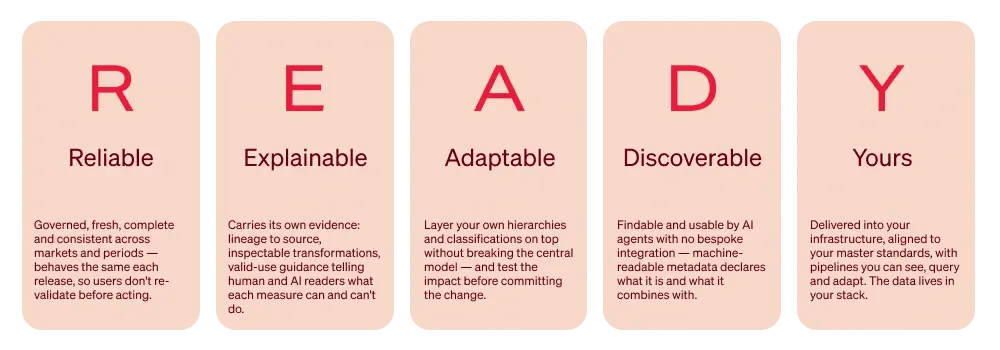
Redslim's READY standard. Source: Redslim
This is not a claim that READY data automatically makes an AI initiative successful. Models, governance, human judgment, and operating design still matter. It does mean that the data foundation is less likely to become the hidden obstacle that blocks AI success.
From connected data to agentic media
The long-term opportunity is compelling. Connected media and sales data can support ongoing analytics. Those analytics can feed decision-support tools. Over time, trusted outputs may inform more automated and agentic workflows across planning and activation.
But the chain breaks if the foundation is inconsistent or lacks context. A company cannot safely accelerate decisions if it cannot explain the inputs behind them.
Redslim’s role is deliberately focused: turning fragmented, ever-changing external data into READY data products, maintained as a managed service within or aligned with the client’s stack. The aim is to give people and machines a dependable, context-rich foundation while allowing internal teams to concentrate on activities and use cases that will drive commercial success.
The organizations that realize the full value of their data and optimize their media marketing, identifying opportunities that AI presents along the way, are most likely to be those with robust, harmonized data foundations.
Watch the Webinar on Demand
Watch the webinar on demand to hear Redslim’s Business Development Director (APAC), Steven Lindsey, and Global Commercial Director, Nils Thott discuss the future of AI-ready media foundations, always-on analytics and the path toward agentic workflows.