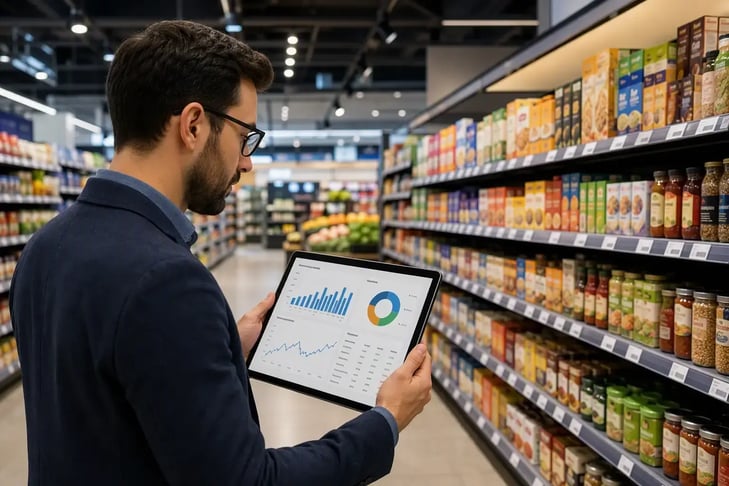
Category management runs on data. Every planogram change, every assortment decision, every shelf reset starts with a number somewhere — a share point, a distribution gap, a rate of sale. The strategy only holds up if that number is right. And for most category managers, that's the hard part.
The theory of category management hasn't changed much in the last twenty years. What's changed is the volume, speed and fragmentation of the data feeding it. With retailers updating assortments faster, new data sources appearing constantly and markets diverging, category managers need harmonized in-market data that actually holds together in order to get the shelf strategy right.
The payoff for getting this right is well documented. McKinsey & Company reports that in 6 to 18 months, a data-driven approach to category planning can lead retailers to "achieve a sales uplift of 3 to 5 percent and a net margin improvement of one to four percentage points".
That's not a small edge, and it's not coming from a better strategy deck. It's coming from better data and trusted, user-friendly business intelligence (BI) tools.
The data behind every shelf decision
A shelf strategy should always be driven by good-quality, accurate, and nearly real-time category data. Category managers commonly access this data from:
- POS and sell-out data that indicate the quantity of items that have actually moved at SKU, a given store level, and during the week
- Loyalty and shopper data that help retailers to recognize the buyer, his/her frequency of visiting to buy, and what he/she is switching from
- The performance benchmarks of the category in terms of the market share and pricing compared with rivals
- Distribution data that shows where category, brands and SKUs are available and where they are not
- Planogram and shelf data documenting the layout of the store
- Leaflet and promotion data to track the promotion pressure across channels and banners
The issue here is that not at all these data sources share the same native language. Different agencies have different category definitions, for example, a "family pack" might be a "value pack" in a different market, with also a different weight cutoff. Add to this that retailers also have separate reporting cycles, frustrating close to real-time analysis, then multiply that across markets, retailers and data providers, and your real job becomes reconciling all of it into something that compares like-for-like, even before moving to the strategy.
This is where in-market data harmonization becomes the essential foundation of category management. Without it, a category review isn't measuring the category. It's measuring whichever data source happened to be easiest to pull that week.
Where category managers get stuck
The friction shows up in predictable places:
- Fragmented sources. Internal POS data, retailer scorecards, and syndicated market data rarely reconcile cleanly. Each has its own hierarchy, its own refresh cycle and its own blind spots.
- Retailer-by-retailer inconsistency. Reviewing a particular category across five different retailers usually requires considering five different category trees in those five different retailers, five different definitions of promotion and a lot of different views of what counts as "core range".
- Stale refresh cycles. By the time data is cleaned, mapped and validated, the shelf reset it was meant to inform has already gone to print.
- Global frameworks that don't survive contact with local markets. A category strategy drawn-up at headquarter level may imply market-wide stability in different regions, which is hardly ever the case since buying behaviors of consumers, retailer influence, and regulations vary a lot with local nuances.
None of these are strategy problems. They're data harmonization problems that get mistaken for strategy problems, usually discovered halfway through a category review when the numbers from two sources won't agree.
Turning data into shelf decisions
Only when your data sources are connected and harmonized, and your numbers add up, can you start thinking about the shelf strategy.
Let’s say a distribution report shows a sub-segment — travel-size formats, for example — under-indexing in a specific retailer compared to the wider market. Alone that piece of information is only a small fragment. But combined with loyalty data showing repeat purchase from a growing shopper segment, and shelf audit data showing the sub-segment squeezed into a single facing at the bottom of the product display, it can transform into a shelf decision: adding facings, placing the whole display at eye level, and revising the planogram at next restocking.
That chain only works if every link in it is trustworthy, meaning that the distribution data, the loyalty data and the shelf data are all measuring the category the same way. This is the difference between category management as a reporting exercise and category management as a genuine driver of shelf strategy. The strategy step is usually the easy part. Getting the inputs to agree with each other is where the real work happens.
Local versus global alignment
Global organizations feel this tension constantly. The head office wants one category strategy, one set of principles, one scorecard. But shelf strategy lives at the market level. It differs in terms of local players (retailers), the legal environment, the way consumers do shopping and even the definitions of product categories. A categorization logic that is perfect for German retail may not be aligned with that of British or Brazilian ones.
Brands that manage this well do not impose a cookie-cutter model on each market. Instead, they build a validated global data model, then allow local hierarchies, classifications and business rules to sit on top of it, so markets can flex and maintain granularity, without losing comparability at the global level. That's the practical meaning of local and global alignment in category management: consistency where it matters for enterprise, above-market reporting, and granularity where it matters for the shelf.
Redslim's Local and Global Alignment use case covers exactly that, in more detail, for organizations managing category data across multiple markets at once. We reconcile local market definitions, category structures and business rules with global reporting requirements, creating trusted, enterprise- and AI-READY data products that support confident decision-making at every level – both local and global.
Common mistakes to avoid
During the extensive collaboration with our clients, we have seen a few patterns showing up again and again in category management done badly:
- Acting on stale data. A shelf strategy based on last quarter's distribution numbers is a strategy for a category that no longer exists. McKinsey has made the same point at the merchandising level: retailers should "seek a more diverse set of data sources instead of an overreliance on historical data".
- Ignoring regional nuance. Applying a global category strategy without adjusting for local retailer dynamics usually means it gets quietly ignored at market level.
- Treating category management as a project, not a cycle. A one-off data cleanup fixes the data as it exists on the day of the cleanup. But external data keeps moving and data management has to be a continuous, not a one-time exercise before a big review.
What good category management actually looks like
The category managers who consistently make good shelf decisions aren't working from a fundamentally different strategy playbook than everyone else. They're working from a position of strength on two factors:
- Data they can actually trust: harmonized data across sources which is consistent across markets, and current enough to still be true by the time the reset happens
- BI tools (and now AI agents) that provides clarity across countries, categories, channels and banners and which enable smooth category management analysis and decision making, so that time can be spend on making category adjustments that drives sustainable growth
The combination of aligned data and intuitive BI tooling is a critical success factor, enabling FMCG suppliers to build stronger relationships with retail partners by spending less time preparing and processing data and more time generating insights and making better business decisions.
Get that right, and the shelf strategy mostly writes itself. Get it wrong, and no amount of strategic thinking will save a planogram built on numbers that don't agree with each other.
Get in touch to talk through what a connected, harmonized data foundation could look like for your category management and shelf strategy.